2026: A Fundamental Restructuring of the Social System
From a growth society to a society of existing resources: why the rules of Chinese society are changing fundamentally in 2026, and what that means for the individual. With a film in English, Dutch and Chinese.
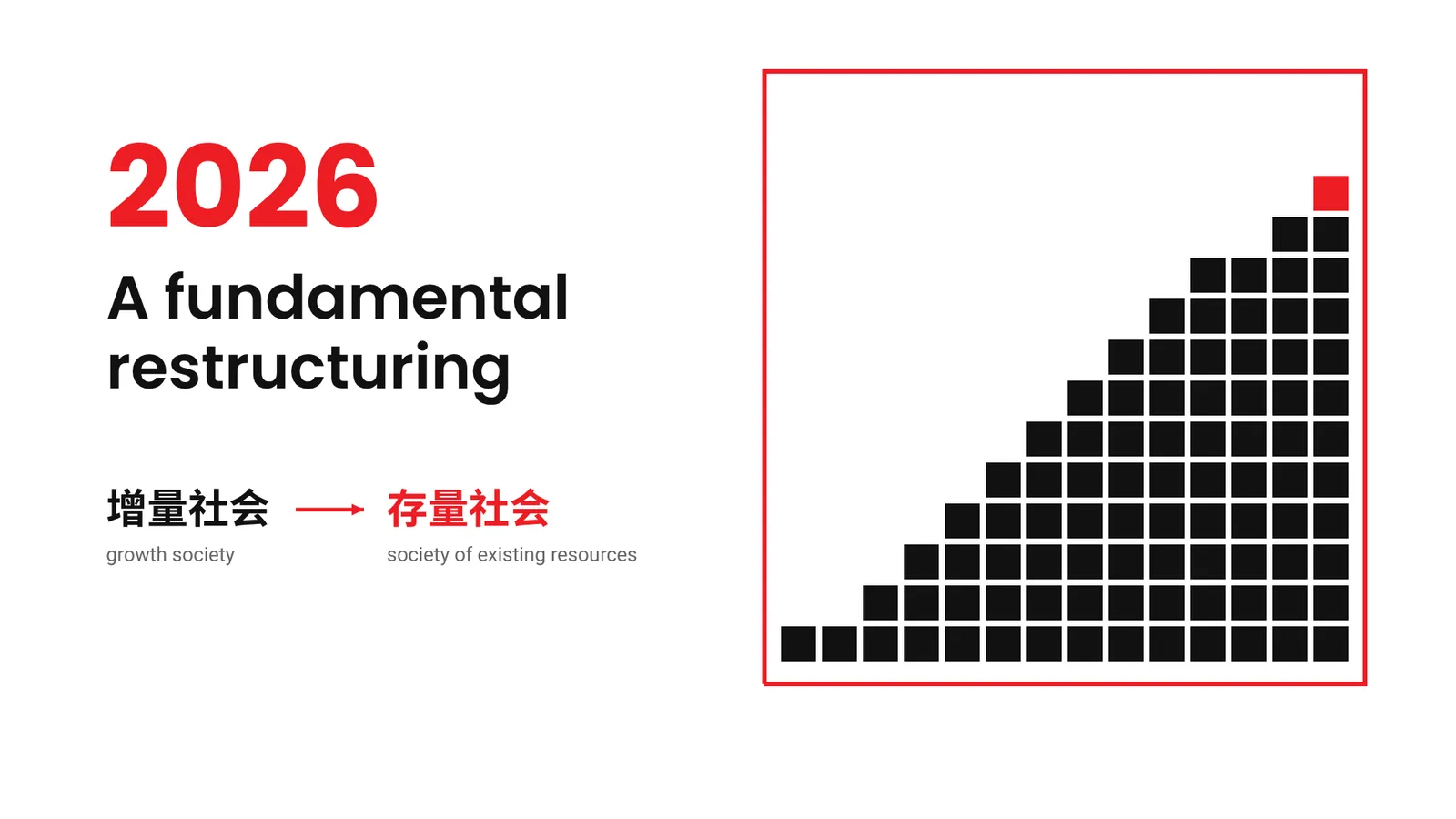
In 2026, we are not simply living through an economic transformation. What we are seeing today is a fundamental restructuring of the system on which our society is built.
Many people still try to understand today's China with the thinking patterns of the past forty years. They use their past experiences of success to plan their future, without realising that the fundamental rules of society are changing.
We are standing at the beginning of a new social era.
We call the old system the 'growth society' (增量社会). The new system is the 'society of existing resources' (存量社会).
Whoever understands the difference between the two systems can better understand what is happening in China today, and how it will change the future of the individual.
The film 14:50
The article as an animated film, read by an AI voice. The film is also available in Dutch and Chinese.
1. The Old System: the Growth Society
The population as the engine of economic growth
For the past forty years, China's most important task was to accelerate industrialisation and urbanisation.
What was the most important economic resource in that period?
The population.
A huge population meant an abundance of labour, a gigantic consumer market and a constant source of economic growth.
The entire social system was designed to turn this demographic advantage into productivity.
Education worked as a selection mechanism. Diplomas were the proof that someone was suitable. Individuals were trained to function within a standardised system.
Schools supplied people with the right knowledge and skills. Exams decided who was suitable. Diplomas confirmed their qualifications, and companies then hired them.
Whoever studied hard, earned a diploma, found a job and followed the rules of society could improve their standard of living.
That worked because the whole economy kept on growing.
Cities had to be built. Companies needed staff. Factories were looking for workers. The property sector needed buyers, and the service sector new consumers.
It was a society in which people could get ahead simply by being part of a growing system.
You did not necessarily have to be exceptionally creative. Nor did you have to understand the deeper mechanisms of society.
Whoever worked hard, followed the rules and met expectations could share in the economic progress.
That was the fundamental logic of the growth society.
2. The New System: a Society of Existing Resources
From continuous growth to preserving stability
Today, the conditions that made economic growth possible are changing.
The demographic advantage is shrinking. Urbanisation has entered a new phase. The property sector no longer grows as it used to, and traditional industries are under increasing pressure.
At the same time, artificial intelligence, robotics and automation are raising productivity at an unprecedented pace.
Society no longer needs the same enormous numbers of workers to carry out standardised work.
As a result, the most important task of the social system is changing too.
In the past, everything revolved around expansion and growth.
Today, it is increasingly about preserving stability, while society prepares for a possible technological breakthrough.
This is the transition from a growth society to a society in which existing resources, positions and opportunities compete ever more fiercely with one another.
In the past, economic expansion constantly created new jobs, new companies and new opportunities.
Today, the available resources, jobs and chances of prosperity are becoming more limited, and competition for them is increasing.
A diploma, a profession or years of work experience no longer automatically guarantee someone's future position in society.
Where the old system rewarded people who met the norms, the new system is starting to judge people on their ability to create unique value.
3. The New System: Protection at the Bottom, Freedom at the Top and Pressure on the Middle Class
According to the author, this is one of the most important features of the new social system.
The system carries out two seemingly contradictory tasks at the same time.
At the bottom, it tries to protect the population.
At the top, it gives entrepreneurs, innovators and creative people more room to develop.
Why is that protection at the bottom necessary?
Because traditional economic sectors can absorb fewer and fewer workers, while new technologies are increasingly replacing human labour.
The government must prevent large-scale unemployment and loss of income from leading to social instability.
That is why government spending, social protection and other stabilising measures do not necessarily serve to make everyone richer.
Their main function is to prevent large groups of people from falling below a minimum standard of living.
The aim of that protection is to preserve the stability of the system, not to guarantee social progress for everyone.
At the same time, people at the top of society, such as entrepreneurs, technological innovators and people who can independently create new value, are getting more and more opportunities.
Because society has less need for large numbers of people who follow existing instructions.
It increasingly needs people who can develop new ideas, products, services and economic activities.
The group that comes under the most pressure is the traditional middle class.
These people have diplomas, professional knowledge and work experience. They know the rules and are used to solving problems with existing methods.
In the past, these qualities were the foundation of their stable careers and social position.
Today, it is precisely these skills that artificial intelligence can take over more and more easily.
4. Artificial Intelligence Undermines the Traditional Value of the Middle Class
Why is the AI revolution so important?
Because AI is not just a new technology; it is also redefining the economic value of human labour.
In the past, someone could earn a good position in society by mastering complex knowledge, processing information, carrying out professional analyses or making precise calculations.
Lawyers, accountants, programmers, analysts and many other knowledge workers drew their economic value from these skills.
Today, artificial intelligence is penetrating ever deeper into these professions.
AI can process knowledge, analyse data, produce texts, solve problems and carry out countless standardised intellectual tasks.
What once required years of education and training may, in the future, be done by an intelligent system.
What does this mean?
The knowledge advantage on which the traditional middle class built its position in society is getting smaller and smaller.
The hardest consequences will not necessarily be felt by the lowest-paid workers, nor by the people who have capital and exceptional creative abilities.
It is above all those who built their position on diplomas, specialist knowledge, fixed procedures and precise execution.
They were among the most successful groups in the old system.
But in the new system, it is precisely they who must redefine their value.
Because AI is beginning to take over exactly the skills they used to be so proud of.
5. Not Just an Economic Transformation, but a New Selection of Human Qualities
If society needs fewer and fewer standardised workers, what can an individual still rely on?
According to the author, that is the deepest question of this social change.
The traditional education and social system taught people to look for correct answers.
From childhood, people learn to study, sit exams, earn diplomas and then function within an organisation.
They are used to others telling them what to learn, which direction to take and what counts as success.
This behaviour suited the industrial age perfectly.
Industrialisation required discipline, efficiency, uniform standards and large-scale cooperation.
But a society that depends more and more on creativity calls for a different type of person.
People who can think for themselves.
People who dare to question existing rules.
People who discover problems themselves, instead of only solving the problems others put in front of them.
People who can create value without constantly depending on outside approval.
That is why this change goes much further than the disappearance of certain professions.
It is about a new selection of thinking patterns, personality traits and survival skills.
With the phrase 'the dependent adults disappear, the creators remain', the author means that people who constantly wait for instructions, look for standard answers and depend on society will find life increasingly difficult.
Whoever, on the other hand, can think independently, dares to take responsibility, can bear risks and creates new value, will be able to find new opportunities.
6. Deep Insight and the Ability to Turn Ideas into Results
In the new social system, knowledge alone is not enough.
Understanding the world and being able to change reality are two different skills.
Someone can read many books, understand economic developments, analyse the impact of artificial intelligence and have deep insight into social change.
But if that person cannot turn their knowledge into concrete action, all that insight remains theoretical.
The reverse is also true.
Someone can work extremely hard and do the same tasks for years, without ever asking whether that work still has value or will soon be replaced by technology.
So hard work, too, is no automatic guarantee of success.
The people who will be truly competitive in the future must combine two qualities.
They must understand how the world is changing, and be able to turn their insights into concrete results.
First, understand what is happening.
Then, discover what opportunities are emerging.
And then, actually act.
The greatest danger is not that someone does not work hard enough, but that they keep working extremely hard according to a model that is losing its value.
That is why the competition of the future will not take place between individuals alone.
It will also be a competition between different ways of thinking, different creative abilities and different personality structures.
7. The Way Out: Discovering Your Own Inner Source of Creativity
In ancient Chinese philosophy, in Laozi's Daodejing to be precise, there is a thought:
'绵绵若存,用之不勤。'
Freely translated: A source that seems ever present, and from which one can draw without ever exhausting it.
This thought refers to an inner strength that endures and can bring forth energy again and again.
Applied to today's social transformation, this leads to a fundamental question.
If diplomas no longer offer a guarantee, professions give less security and existing knowledge can constantly be surpassed by AI, what is really left of an individual?
According to the author, the answer lies in discovering your own inner source of creativity.
That may be a special talent.
A unique way of thinking.
An exceptional insight.
The ability to combine different fields of knowledge, experiences and resources in a new way.
These qualities do not necessarily have to be recognised by a school, university or employer.
They come from a personal understanding of the world, self-knowledge and a constant urge to explore and create.
In the old growth society, people tried to find a suitable place within the existing system.
In the new social system, they must ask themselves a different question:
Can I create a place myself that did not exist before?
That is the essence of the transition from a standardised existence to independent creation.
8. 2026: Yesterday's Formula for Success May Become Tomorrow's Greatest Obstacle
The transition to a new social system does not mean that the old world disappears overnight.
Old institutions, professions, education systems and forms of income distribution will continue to exist for a long time.
But the fundamental rules that shape the future are beginning to change.
One part of the population keeps striving for higher diplomas, more stable jobs and a classic career in society.
Another part uses artificial intelligence, technology and new forms of organisation to create economic opportunities that were hardly imaginable before.
The distance between these two ways of life will keep on growing.
An individual's future will no longer be determined solely by their accumulated knowledge, diplomas, work experience or social status.
Far more important will be whether someone understands the new rules and is able to redefine their own value.
China's development over the past forty years was above all a process of large-scale industrialisation and urbanisation.
The next social transformation, by contrast, will revolve around a fundamental redefinition of human skills, economic value and even the meaning of human existence.
This change will go much further than an ordinary industrial modernisation.
It will affect not only the economy, but also education, the labour market, the structure of society and the way people judge their own worth.
In the past, society mainly needed large numbers of qualified people. In the future, it will increasingly need people who can create something themselves.
In the past, personal progress was mainly about finding a place within the system.
In the future, progress will depend more and more on the ability to understand the system, adapt to it and discover new opportunities outside existing structures.
This fundamental restructuring has already begun.
The most important question is no longer when the old era will end.
The question is whether you, when the new era fully arrives, can think, act and create independently enough.
This is not an ordinary change in the economic cycle. It is a fundamental selection based on human value, personality and the ability to survive independently.
Are you able to wake up, discover your own inner strength and find a source of creativity from which you can keep drawing new possibilities?
According to the author, that is the only way to the future.