Shanghai Diamond Exchange
China's only state-approved diamond exchange: a bridge to Antwerp.
By China Connect
The film 05:20
- Sector
- Diamond trade
- Chinese name
- 上海钻石交易所
- Programme
- Day 1 · 11 Oct 2026 · Shanghai
Every diamond that enters or leaves China through ordinary trade passes through one building in Pudong: the Shanghai Diamond Exchange (上海钻石交易所, or SDE). Founded in 2000 with approval from China's State Council, the exchange has around 400 members and brings customs, the tax authorities, banks and a grading laboratory together under one roof. Today it plays a double role: it is the gateway for natural diamonds coming into China and the export channel for the lab-grown diamonds China produces itself. It was on the programme for day 1 of the China Business Mission 2026, as the most traditional trading institution of the days in Shanghai.
An idea from Antwerp's diamond district
The story starts in Belgium. According to Lin Qiang (林强), who co-founded the exchange and has led it since it opened, Zhu Rongji visited the Antwerp diamond bourse in 1991 as Party secretary of Shanghai. He came back with a simple question: why doesn't Shanghai have one? The idea only gained momentum in 1997, when an Israeli business group raised it again and a Chinese mission toured the diamond centres of Belgium, Israel, the United Kingdom and the United States, among others. Zhu became premier in 1998, which gave the project political backing.
The exchange opened on 27 October 2000 in the Jin Mao Tower in Lujiazui. In 2009 it moved to its own China Diamond Exchange Center on Century Avenue, a building of around 49,000 m² with its own security, banks, logistics and grading labs, as the Gemological Institute of America described after a visit.
From an Antwerp idea to African diplomacy
- 1991Zhu Rongji visits the Antwerp diamond bourse
- 2000Opens in the Jin Mao Tower, 27 October
- 2002All ordinary diamond imports must go through the exchange
- 2006Net 4% VAT on polished diamonds
- 2010'Diamonds Love Antwerp' with the AWDC
- 2026Beijing Declaration with Botswana, Namibia and South Africa
How a tax made smuggling pointless
Before 2000, a large share of diamonds entered China unchecked. Legal importers paid import duty, 17% VAT and a 10% consumption tax, so smuggling paid off. The SDE was therefore first and foremost a fiscal project. In 2001 the import duty was scrapped and the consumption tax moved to the point of sale. From 2002, all diamond imports through ordinary trade had to go through the exchange. In 2006 came the decisive step: polished diamonds that reach the Chinese market via the exchange carry a net VAT of 4%, because the rest is refunded.
The building works as a closed customs zone. A shipment arrives sealed, is opened, weighed and graded inside the exchange, and members trade with each other in dollars. Only when a stone leaves the exchange for a Chinese jeweller are taxes collected and an official invoice issued. Membership is no formality. In GIA's description, the exchange required at least three years of experience in the trade, two sponsors among existing members, a probation year and a refundable deposit of 20,000 dollars.
From record year to deep slump
The model worked. According to the Pudong district, total trade through the exchange rose from 14 million dollars in 2001 to 4.24 billion in 2019. In 2021 it hit a record 7.08 billion dollars, 81% more than a year earlier, with record polished imports of 2.92 billion dollars, as the exchange reported in early 2022.
Total trade through the SDE
Then the market turned. According to figures published by the exchange and Chinese media, polished imports fell to around 400 million dollars in 2024. High inventories at jewellers, record gold prices, a weaker economy and the rise of lab-grown diamonds all played a part. A cautious recovery followed in 2025: in the first eight months, polished imports through ordinary trade rose 41.5% to 2.35 billion yuan.
Natural diamonds in, lab-grown diamonds out
The exchange set up to bring diamonds in is now also growing as an export platform. According to Lin Qiang, China produces more than 60% of the world's lab-grown diamonds. In the first half of 2026, lab-grown exports through the exchange rose 65.3% to 1.41 billion yuan, Xinhua reported in August. More than a tenth of members now make or export lab-grown diamonds, and Shanghai customs opened a dedicated window for fast clearance. Part of that output finds an industrial use: diamond conducts heat exceptionally well, which makes it attractive for cooling AI chips.
One exchange, two directions
Natural diamonds: imports
- Sole channel for imports through ordinary trade
- Net 4% VAT on polished diamonds
- Jan-Aug 2025: 2.35bn yuan, +41.5%
Lab-grown diamonds: exports
- China makes more than 60% of world output
- H1 2026: 1.41bn yuan via the exchange, +65.3%
- Over a tenth of members make or export lab-grown diamonds
The two tracks rub against each other. The SDE promotes natural diamonds to Chinese consumers, with campaigns and influencers on platforms such as Xiaohongshu, and seeks new trading partners: in August 2026 it signed a cooperation agreement with the Qatar Diamond Exchange. At the same time it facilitates exports of lab-grown diamonds, which put pressure on the price of smaller natural stones.
Antwerp: partner and mirror image
For Belgian readers, the link with Antwerp is the most intriguing part. During the 2010 World Expo in Shanghai, the Antwerp World Diamond Centre and the SDE signed the 'Diamonds Love Antwerp' agreement: diamonds shipped directly from Antwerp to the exchange can receive a quality label. Lin Qiang said at the time that he wanted legal channels for diamonds from Antwerp to China. Belgian traders are members of the exchange; GIA counted twenty-three in 2013.
Since 2004 the SDE has been a member of the World Federation of Diamond Bourses, where it holds one of seven permanent board seats and Lin Qiang is vice-president. On 15 September 2026 the exchange hosted the Beijing Declaration on Natural Diamonds and Sustainable Development in Beijing, together with representatives of Botswana, Namibia and South Africa. De Beers chief executive Al Cook, the Natural Diamond Council and the World Diamond Council acted as witnesses, Rapaport reported. The declaration aims to connect African producing countries directly with Chinese consumers, through local value creation, training and clear information on origin. That is the intermediary role Antwerp has traditionally played.
A monopoly that still has to sell
The SDE's strength is policy: a single legal channel and a favourable VAT rate. That gives it a solid position as long as the rules hold, but it offers no protection against consumers who lose interest. That is why a trading platform now behaves like a brand builder and a diplomat. For European companies, that shift is the point: anyone selling diamonds to China goes through Shanghai, and anyone buying Chinese lab-grown diamonds increasingly receives them through the same gateway. In a regulated sector, this is how business in China works: the state sets the channel, the market sets the volume. More on that logic in doing business in China.
The presentation 26 slides
Shanghai Diamond Exchange (上海钻石交易所) · Company visit Shanghai · Translated from the Dutch original.
- 01 Opening: what the Shanghai Diamond Exchange is, at a glance
- 05 The story: from an idea from Antwerp to China's diamond gateway
- 09 Who leads the exchange and how it works
- 12 Why the SDE is innovative
- 15 A two-track market: natural and lab-grown diamond
- 17 The SDE and Europe
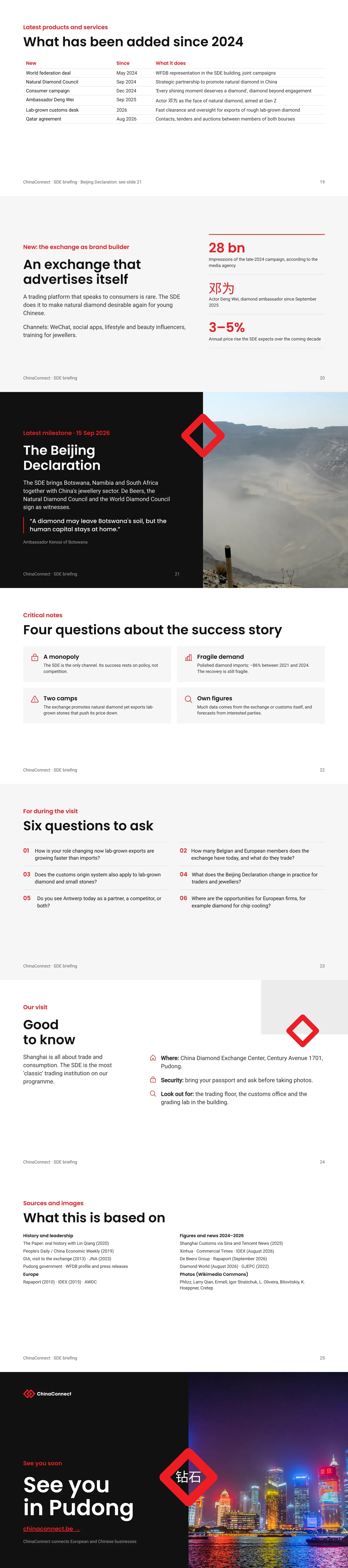
- 19 Latest products and services 2024-2026
- 22 Critical notes and preparing for the visit