USTC Silicon Valley
Innovation zone around the USTC university: how Hefei turns a university into a startup factory.
By China Connect
The film 05:26
- Sector
- Innovation
- Chinese name
- 科大硅谷
- Programme
- Day 6 · 16 Oct 2026 · Hefei
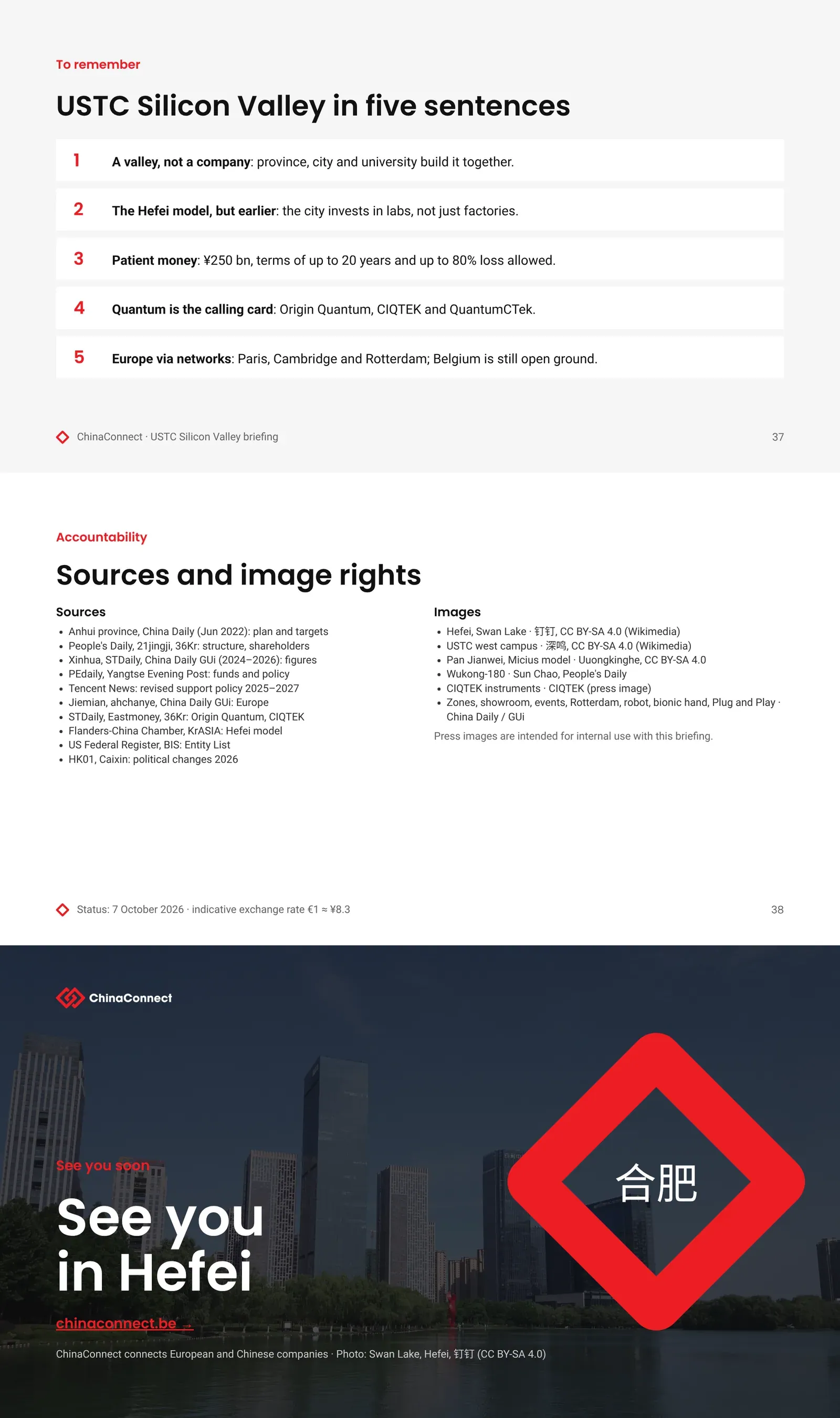
USTC Silicon Valley (科大硅谷) is not a company but an innovation zone in Hefei, built around the University of Science and Technology of China (USTC). Anhui province launched it in 2022 to keep researchers and their inventions in the city, using public money that is allowed to wait and with government as the first customer. By August 2026, according to Chinese state media, the zone had attracted more than 70,000 talents and 2,500 new tech companies, but not all of its 2025 targets were met. The China Business Mission 2026 delegation had the zone on its programme on day 6.
What exactly is USTC Silicon Valley?
The name refers to Kēdà (科大), the common abbreviation of the university, and to the American model. In English the name Grand Union of Innovation (GUi) is also used. There is no walled campus: the zone is a network of buildings, labs, funds and services spread over four areas of Hefei, mostly in the national high-tech zone.
Three parties founded it: Anhui province, the city of Hefei and the university. Day-to-day work lies with a platform company set up in August 2022. According to Chinese business media, its shareholders include not only state-owned companies but also firms founded by alumni, among them speech technology company iFlytek.
USTC Silicon Valley in August 2026
Why does Hefei use a university as its engine?
USTC was founded in Beijing in 1958 by the Chinese Academy of Sciences and moved to Hefei in 1970. It is relatively small but strong in physics, above all in quantum technology: in 2016 Pan Jianwei's (潘建伟) group put Micius, the first quantum satellite, into orbit. USTC gave rise to companies such as iFlytek, founded in 1999 by a PhD student, and quantum firms such as QuantumCTek and Origin Quantum.
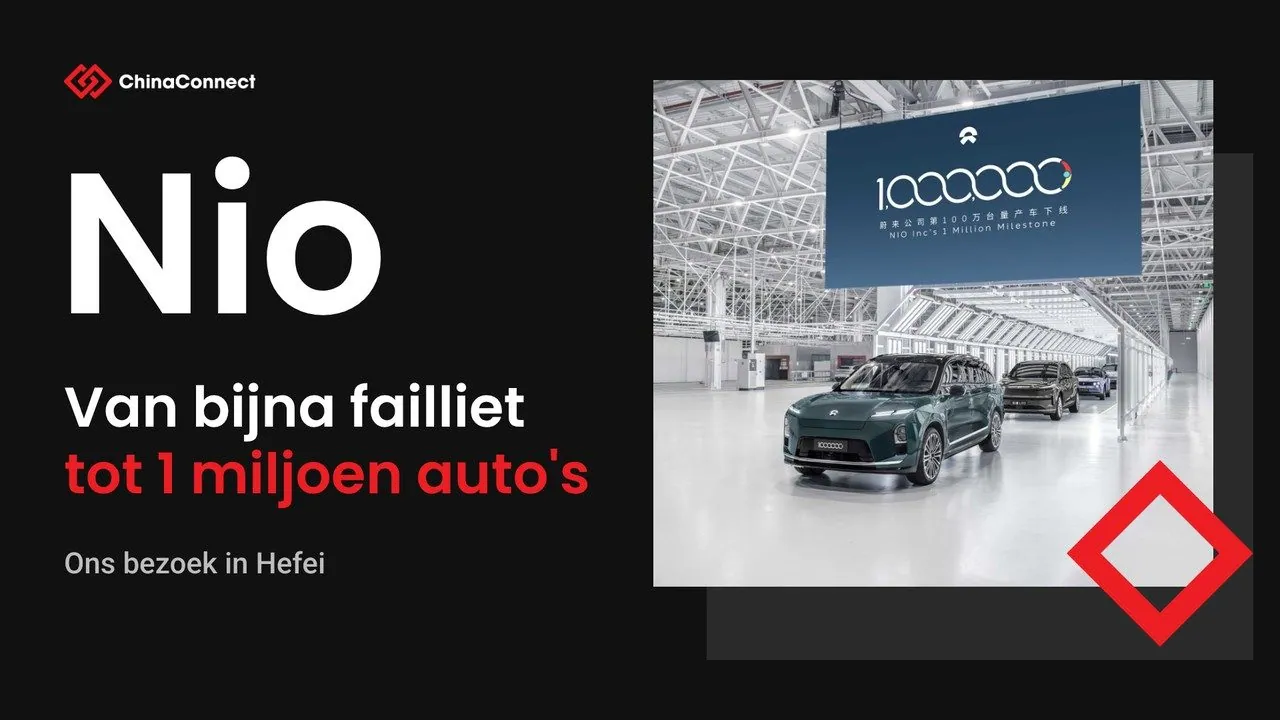
Yet for a long time anyone who wanted to start a business left for Beijing, Shanghai, Shenzhen or abroad, where the capital and customers were. Meanwhile Hefei had made a name as a city that invests itself, first in BOE's display factories and later in the rescue of NIO. With the zone, that model moves up the chain: the city no longer invests only in factories, but already in labs and researchers starting out. You can read more about that approach in our portrait of Hefei.
How does a researcher become an entrepreneur here?
The zone sums up its offer in three Chinese phrases: 找人、找钱、找场景, finding people, finding money and finding an application. In August 2026 assistant president Wu Dan described the task to Science and Technology Daily as "finding people, money and applications for the science drifters". Science drifters (科漂) are researchers and tech entrepreneurs from outside the province.
From lab to company in Hefei
- 01Ownership up frontThe team co-owns the patent
- 02Soft landing15 days free stay, 6 months rent support
- 03Seed moneyUp to 5 million yuan
- 04First customerAssignments from city and state firms
- 05Patient capitalFunds with terms of up to 20 years
The approach to ownership stands out. USTC gives research teams part of their patent up front, instead of rewarding them only afterwards. Newcomers to Hefei get up to 15 days of free accommodation and workspace at one of ten welcome stations, up to six months of rent support and up to 5 million yuan in start-up funding. A municipal centre turns the needs of the city and state-owned companies into concrete assignments that start-ups can bid for. And the money can be patient: in May 2026 Anhui extended the term of government venture funds to 20 years and now assesses them over three to five years rather than annually (Xinhua).
What has the zone delivered so far?
The money is there: more than 200 funds with over 250 billion yuan between them. For 2025 the 2022 plan also aimed for more than 100,000 talents, 10,000 tech companies and institutions, and at least 50 listed companies and unicorns (The Paper). At 70,000 talents the first target was missed, and we found no official count of listings and unicorns.
From university to innovation zone
- 1958USTC founded in Beijing
- 1970The university moves to Hefei
- 2016Quantum satellite Micius launched
- 2022Anhui launches USTC Silicon Valley
- 2023Centre in Paris, agreement in Rotterdam
- 2026Wukong-180 online, CIQTEK lists
The flagships come from quantum technology. In May 2026 Origin Quantum brought the Wukong-180 online, a quantum computer with 180 computing qubits. According to Science and Technology Daily, its predecessor was used remotely from more than 160 countries. In June the company raised almost 3 billion yuan in a pre-IPO round (China Securities Journal). CIQTEK, which makes quantum sensors and electron microscopes, listed on Shanghai's STAR Market in August 2026 and closed its first day 419 per cent higher (Cnfin). Two months later, however, its market value had fallen from more than 44 to about 28 billion yuan (C114).
What does this mean for Europe and Belgium?
In Europe the zone works the other way round from a Chinese manufacturer: it looks for talent, technology and partners willing to move to Hefei. In 2023 an innovation centre opened in Paris, run by a Franco-Chinese incubator alliance from Lyon, and the platform company signed an agreement in Rotterdam with an association of Chinese scientists and engineers in the Netherlands. There is also a centre in Cambridge. We found no Belgian centre or Belgian partner.
For a European team there are roughly three ways in: join a partner centre, keep working in Europe and register an entity in Hefei, or bid for a concrete assignment from the city. Almost all support depends on registration and activity in Hefei. How actively the zone recruits became clear in October 2026: 41 representatives of 34 teams, selected from 1,202 entries, received training ahead of the final of its global competition for science drifters (Xinhua Silk Road).
What should you watch out for?
- Growth relies heavily on public money and public customers. Which companies would survive without that support is not yet clear.
- USTC and Hefei's national quantum laboratory have been on the US Entity List since May 2024 (Federal Register). Cooperation involving technology of US origin can therefore fall under export rules.
- Quantum technology is dual-use. According to Chinese business media, defence group Norinco led Origin Quantum's latest funding round.
- The model depends on local leaders, and Anhui got a new party secretary at the end of September 2026.
The real product is the first customer
Europe knows technology transfer, spin-offs and innovation funds. Hefei removes all the hurdles at once: ownership up front, money with a twenty-year horizon, housing around the corner and above all a first customer from its own government. That last element is what Europe most often lacks. Whether the zone also produces companies that can stand without that customer remains to be seen in the coming years. For anyone doing business in China and looking for technology partners, it is in any case a place to know, with eyes open to export rules.
The presentation 39 slides
USTC Silicon Valley (科大硅谷) · Visit Hefei · Translated from the Dutch original.
- 01 Opening: what USTC Silicon Valley is, and why it is not an ordinary company
- 05 The story: the university USTC, the quantum tradition, the spin-offs, the Hefei model and the 2022 launch
- 12 Leadership and structure: founders, platform company, key figures, zones and results
- 17 Why it is innovative: people, money and a first customer, patient capital and ownership for researchers
- 22 Europe: the global network, the European centres, the link with Belgium and how to get involved
- 27 Latest services and products: the platform offer, Origin Quantum, CIQTEK, robots and the 2026 competition
- 34 Our visit: critical notes, questions, key messages and sources