The film 05:39
- Sector
- AR and wearables
- Chinese name
- 灵伴科技
- Programme
- Day 4 · 14 Oct 2026 · Hangzhou
Rokid (灵伴科技), based in Hangzhou, makes glasses with a camera, microphones, small speakers and artificial intelligence. Its top model also shows text in the lenses. Misa Zhu founded the company in 2014 after a career at Alibaba. After ten years of searching, Rokid broke through in 2025 with around 300,000 Rokid Glasses sold, and on 27 October 2026 it unveiled a second generation and its first glasses with a colour display. A visit to Rokid was on the programme for day 4 of the China Business Mission 2026.
Ten years waiting for the right glasses
Misa Zhu (祝铭明) left Alibaba in 2014 to start his own company in Hangzhou. His conviction: after the smartphone, glasses will be the next computer. The technology was not ready for that yet. Google Glass flopped and the smart glasses market stalled for years. Rokid survived with smart speakers, AR glasses for businesses and museums, and glasses that work as a large portable screen, while it kept working on optics and software.
From speaker to AI glasses
- 2014Misa Zhu leaves Alibaba and founds Rokid in Hangzhou
- 2016Smart speakers with a voice assistant keep the company going
- 2018First AR glasses for businesses, the Rokid Glass
- 2020AR guides for museums and glasses for industry
- Nov 2024Rokid Glasses: AI and display in ordinary-looking glasses
- 2025Breakthrough: about 300,000 Rokid Glasses sold
- Oct 2026Rokid Glasses 2 and the full-colour Rokid Color
Only in November 2024 did the Rokid Glasses arrive: AI glasses with a display that look like ordinary glasses. The breakthrough followed in 2025. Zhu spoke of around 300,000 units sold and set the bar for 2026 at one million. "This year sales are not the problem, the key is production," he told 36Kr in May 2026.
What do AI glasses with a display do?
The frame holds a 12-megapixel camera, microphones and speakers. Tiny MicroLED displays project green text into both lenses through waveguides, so the wearer sees information without looking at a phone. The glasses translate conversations and text live, show subtitles and directions, summarise conversations and can act as a teleprompter. The AI assistant runs via the smartphone, and outside China users choose between ChatGPT and Gemini. Rokid builds the glasses and the platform; the intelligence comes from other companies' large language models.
Tom's Guide gave the glasses an Editor's Choice award in April 2026. The reviewer praised the discreet design, the bright display and the translation feature, but was less taken with the camera in low light. In the United States they cost 599 dollars at the time (Tom's Guide). An ecosystem is growing around the glasses: according to Rokid, more than 45,000 registered developers have built over 12,000 AI agents.
How big is Rokid next to Meta?
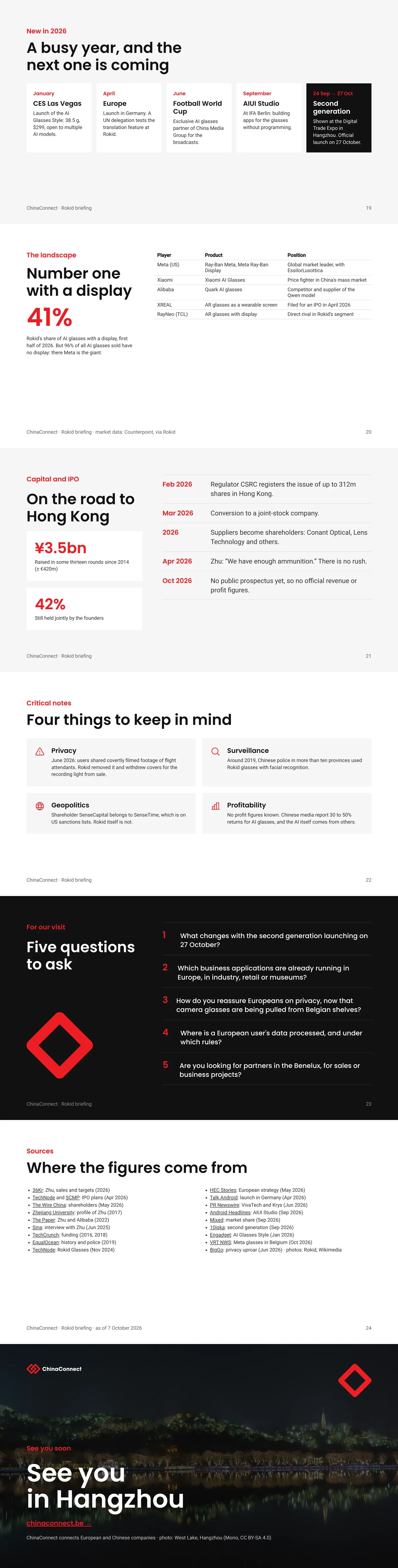
At the end of September 2026 Rokid said that, according to Counterpoint Research, it held 41 per cent of global sales of AI and AR glasses with a display in the first half of 2026. The AI glasses market grew by 263 per cent over that period. The caveat is substantial: the vast majority of AI glasses have no display, and in that segment Meta leads with its Ray-Ban glasses. Counterpoint has also not published the underlying table itself (Mixed).
How small the display segment is
- AI glasses without display 96.0%
- With display: Rokid 1.6%
- With display: other brands 2.4%
Rokid has never published revenue or profit figures. It is, however, preparing a listing in Hong Kong. In February 2026 it received clearance from China's securities regulator for an overseas listing, in March it became a joint-stock company, and internally July was the target date (36Kr). Zhu responded that new products are the priority. By early November 2026 there was still no listing. Rival XREAL filed for a listing in April.
What is new since October 2026?
On 27 October 2026 Rokid unveiled three products in China. The Rokid Glasses 2 keeps the green display but records in 4K and has better audio. It costs from 3,699 yuan and ships in China from 11 November. The Rokid Color is the brand's first pair with a full-colour display, weighs 55 grams and costs from 4,999 yuan. Alongside them comes a ring that controls the glasses with small hand gestures and also tracks heart rate and sleep (Tencent News).
Two new pairs, two directions
Rokid Glasses 2
- Green display in both lenses
- 12 MP camera, 4K video
- From 3,699 yuan
- Ships in China from 11 November 2026
Rokid Color
- Full-colour MicroLED display
- 55 grams
- From 4,999 yuan
- Delivery date not yet fixed
Zhu called it an "iPhone 1 moment" for AI glasses: the concept is in place, but the product is not finished. His iPhone 4 moment will only come when the colour glasses drop below 45 grams, with battery and power consumption the biggest obstacles. Outside China, Rokid plans to show the new models at CES in January 2027 (The Gadgeteer).
Privacy remains the weak spot
Glasses with a camera raise questions that a smartphone does not. In June 2026 Rokid itself came under fire in China. A passenger filmed a Spring Airlines flight attendant with Rokid glasses, and the footage ended up in the community section of Rokid's own app. More covertly filmed clips then surfaced, and online shops sold more than 5,000 covers that hide the recording light (36Kr).
For Europe this weighs heavily. Anyone taking photos and videos of people in the street quickly falls under the GDPR, and the AI assistant passes queries to models from American and Chinese providers. A European buyer will therefore want to know what the glasses record, when others can see that, and where the data is processed.
Glasses only become a computer when people dare to wear them
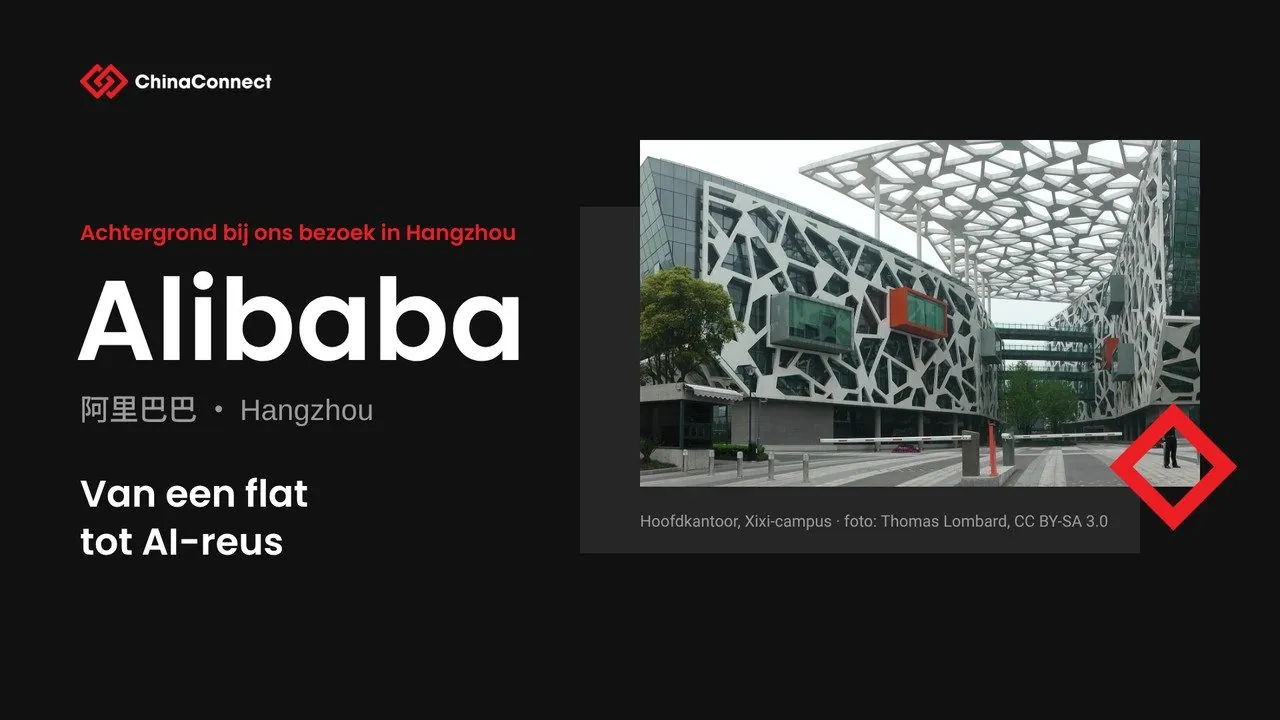
Rokid shows where China is strong: optics, a fast supply chain close by and the willingness to persevere for ten years in a market that did not yet exist. As a result, the glasses are light, affordable and open to different AI models. What Rokid does not control is acceptance by the people around the wearer. For European companies the first opportunity therefore lies in the business applications Rokid has supplied for years: translation at trade fairs, hands-free work instructions, inspections and museum tours. There it is clear who is being filmed and why. To understand the rise of Hangzhou as a tech city, read our story on BrainCo, another Hangzhou company combining hardware and AI, and on Alibaba, where Misa Zhu also worked.
The presentation 25 slides
Rokid · Company visit ChinaConnect · Translated from the Dutch original.
- 01 Opening and Rokid at a glance
- 05 The story behind Rokid and founder Misa Zhu
- 10 Leadership and Rokid's place in Hangzhou
- 12 Why Rokid is innovative
- 13 Products and services
- 17 Rokid in Europe and Belgium
- 19 New in 2026, the landscape and the IPO
- 22 Critical notes and preparing for the visit