Unitree Robotics
Quadruped and humanoid robots, from student project to China's best-known robot maker.
By China Connect
- Sector
- Robotics
- Chinese name
- 宇树科技
- Programme
- Day 3 · 13 Oct 2026 · Hangzhou
Unitree Robotics (宇树科技) of Hangzhou builds robot dogs and humanoid robots that cost a good deal less than those of its rivals, and it makes a profit doing so. In 2025 the company delivered more than 5,500 humanoids and posted revenue of about 1.7 billion yuan. Since August 2026 it has been listed in Shanghai. For Europe, Unitree is at once a supplier, a competitor and a geopolitical file. The company was on day 3 of the China Business Mission 2026.
From a robot dog in a master's project to a company of its own
Founder Wang Xingxing was born in 1990 in Yuyao, near Ningbo. His English was too weak for a master's at Zhejiang University, so he continued his studies at Shanghai University. There, around 2015, he built XDog, a robot dog driven by electric motors, at a time when Boston Dynamics still relied on costly hydraulics. The videos went around the world and buyers and investors followed. After barely two months at drone maker DJI, Wang founded Unitree in August 2016, in a 50-square-metre office in the Binjiang district.
In 2018 it nearly went wrong. An investment of 10 million yuan from DJI's investment arm had been agreed, but it collapsed during an internal anti-corruption campaign. Tencent co-founder Zeng Liqing kept the company afloat, as Chinatechbite reconstructs. Unitree has been known for tight cost discipline ever since. Wang himself describes his method as breaking the impossible down into 300 or 3,000 technical steps.
From XDog to the stock market
- 2015Master's student Wang Xingxing builds XDog, a robot dog driven by electric motors
- 2016Unitree founded in Hangzhou with 2 million yuan from an angel investor
- 2018A planned investment falls through; Zeng Liqing steps in
- 2021The Go1 robot dog comes to market
- 2024G1 humanoid for 99,000 yuan
- 2025More than 5,500 humanoids delivered, 278 million yuan profit
- 2026Listing on Shanghai's STAR Market on 19 August
Why Unitree's robots are so cheap
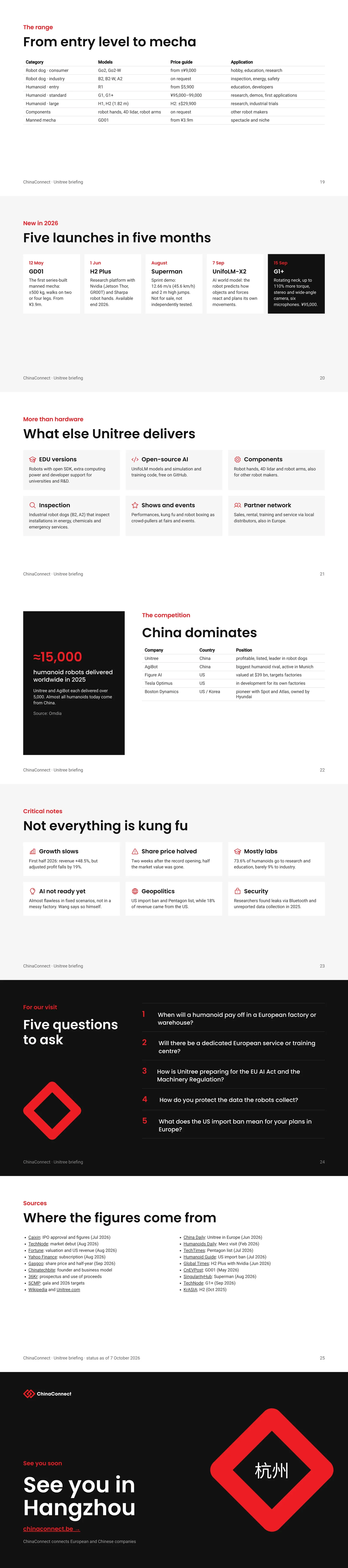
Unitree develops the critical parts itself: motors, reducers, drives and the algorithms that control movement. Sensors, bearings, batteries and chips are bought in. According to the company, more than 95 per cent of its core components are developed in-house. An analysis by SemiAnalysis put the material cost of the G1 humanoid at under 65,000 yuan, against a selling price of 99,000 yuan.
That turns price into a weapon. The G1 has become a widely used platform for universities and AI labs looking for an affordable robot body on which to test their software. Unitree also publishes its own AI models as open source, which ties developers to the platform. In late October Wang called the G1 the best-selling humanoid in the world, with total output he estimates at between 10,000 and 20,000 units.
Revenue has followed. According to the IPO prospectus, it rose from 159 million yuan in 2023 to 393 million in 2024 and about 1.7 billion in 2025, with net profit of 278 million yuan. In the first nine months of 2026 the company already took in 1.82 billion yuan, more than in the whole of 2025.
Unitree's revenue
Who buys a humanoid robot?
Mainly researchers. In the first three quarters of 2025, 73.6 per cent of humanoid sales went to research and education, 17.4 per cent to commercial uses such as demonstrations and events, and barely 9 per cent to industry, according to the prospectus.
Where Unitree's humanoids end up
- Research and education 73.6%
- Commercial use 17.4%
- Industry 9.0%
That is the big question for Unitree: when will the robots move from the lab to the factory floor? Wang expects industrial and business applications to mature faster than robots for the home. He estimates that the AI controlling robots could see a breakthrough within one to three years, comparable to what ChatGPT meant for language models. To find applications faster, Unitree wants to help launch more than 200 partner companies over five years.
Europe as a market, Germany as an example
In 2025, 43.65 per cent of revenue came from abroad, about 732 million yuan, China Daily reports on the basis of the prospectus. Unitree sells in Europe through distributors and, as far as is known, has no European headquarters of its own. German distributor Daniel Kottlarz, who first contacted Wang in 2016, told China Daily in June 2026 that he sells more robots than he can get delivered. Customers, he says, are shifting from universities to logistics, manufacturing and services.
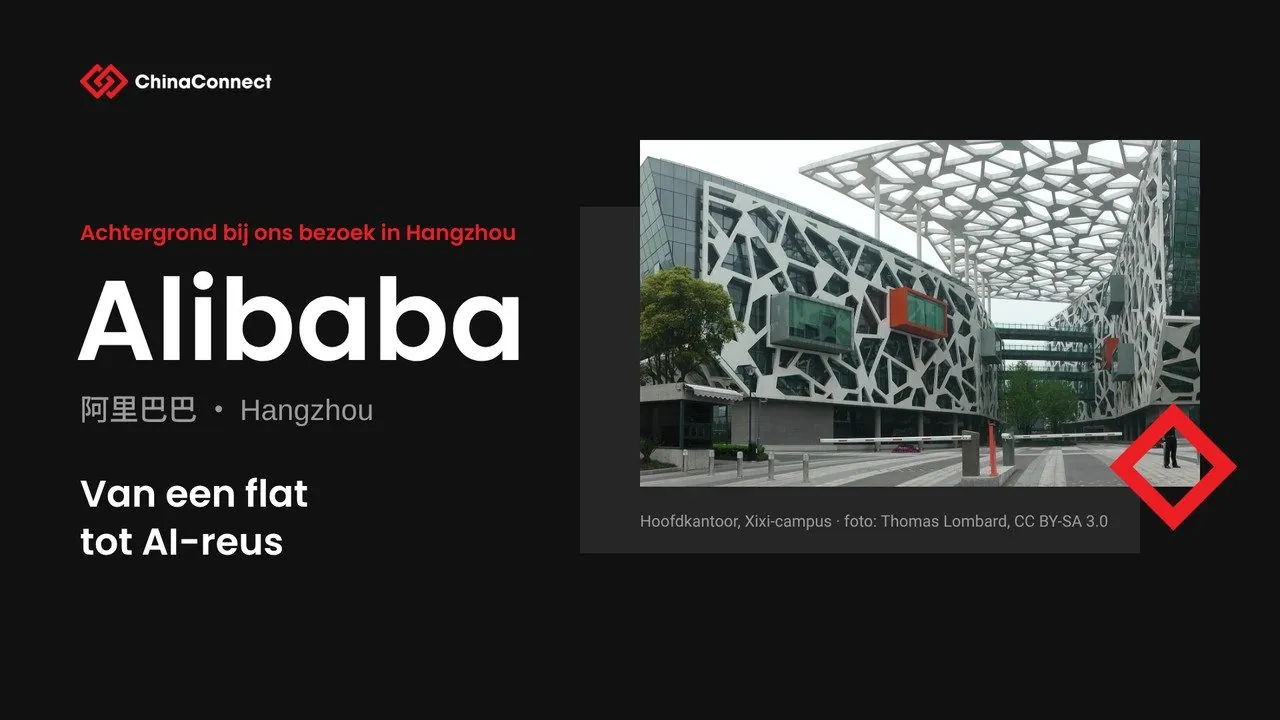
How seriously Europe takes Chinese robotics became clear on 26 February 2026. Chancellor Friedrich Merz visited Unitree during his state visit to China and watched robots box, dance and spar. Wang called the German market promising, especially for industrial applications, TechNode wrote. Why so many of these companies are based in this particular city is explained in our article on Hangzhou.
A stock market debut with highs and lows
On 19 August 2026 Unitree listed on the STAR Market in Shanghai at 150.80 yuan per share, raising about 6.1 billion yuan. The shares opened 629 per cent higher at 1,100 yuan and closed the first day up 460 per cent. Two weeks later the price had roughly halved. In mid-October the shares fell to 404 yuan, before rebounding to almost 696 yuan on 28 October, giving a market value of 281.5 billion yuan.
That same evening Unitree published its first quarterly figures as a listed company. Third-quarter revenue rose 70 per cent to 665 million yuan, TechNode reported. Even so, profit from ordinary operations fell by 19 per cent over nine months. Spending on research and on sales roughly tripled, and the gross margin slipped from 59.8 to 54.0 per cent.
Why European buyers ask critical questions
In the United States the door is closing. In June 2026 the Pentagon added Unitree to its list of companies it links to the Chinese military, a claim Beijing rejects. At the end of July the US communications regulator, the FCC, banned imports of new foreign humanoids and robot dogs, PBS reported. That makes Europe Unitree's most important Western market still open.
There are questions here too. In 2025 security researchers found a flaw in the Bluetooth connection of models including the Go2 and the G1 that allowed robots to be taken over, and reported that the G1 sends sensor data without the user knowing. From 20 January 2027 the new EU Machinery Regulation also applies, alongside the AI Act. Anyone who wants to deploy a Chinese robot in a European factory therefore also has to think about data, cybersecurity and compliance. More on these trade-offs can be found on our page on doing business in China.
A robot body looking for work
Unitree has what few robot makers have: volume, low costs and profit. What it still lacks is a large market outside the lab. That makes the next two years interesting for European industrial companies. Buying a humanoid today mostly means buying a test platform. Waiting may mean buying a working tool later, from a supplier that has lost its American market and is looking all the harder at Europe. The same Binjiang district is also home to carmaker Geely, another Hangzhou company that sees Europe as a second home market.
The presentation 26 slides
Unitree · Company visit ChinaConnect · Translated from the Dutch original.
- 01 Opening and Unitree at a glance
- 04 The story behind Unitree and its founder Wang Xingxing
- 10 Why Unitree is innovative
- 14 Figures and IPO
- 16 Unitree in Europe and the geopolitical context
- 19 Latest products and services
- 22 Competition, critical notes and preparing for the visit