Hema (Freshippo)
Alibaba's supermarket where store, app and fast delivery come together.
By China Connect
The film 04:44
- Sector
- New retail
- Chinese name
- 盒马
- Programme
- Day 2 · 12 Oct 2026 · Shanghai
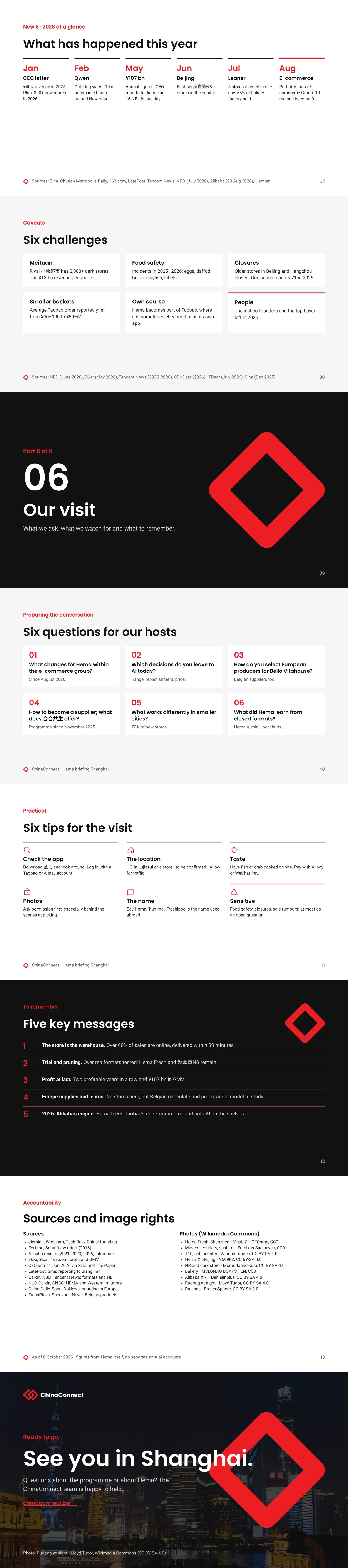
Hema (盒马), known internationally as Freshippo, is Alibaba's supermarket chain in which the store is also the warehouse. In-store shoppers and online customers buy from the same shelves, and more than 60% of transaction volume comes in online, usually delivered within 30 minutes around each store. After years of losses, Hema has been profitable for two fiscal years in a row, and in July 2026 China's chain store federation ranked it the country's second-largest supermarket chain.
How does a store that is also a warehouse work?
The first store opened in January 2016 in Jinqiao, in Shanghai's Pudong district. Founder Hou Yi came from logistics at rival JD.com, and the idea was as simple as it was strict: online sales had to exceed sales at the till. At first the store accepted payment only through the Hema app, so every visitor also became an online customer. Staff walk the same aisles as shoppers with scanners, collect orders in bags and hang them on a conveyor above the shelves, which carries them to the couriers at the back.
From click to front door
- 01OrderIn the Hema app or via Taobao
- 02PickStaff take everything from the regular store shelves
- 03Ceiling conveyorThe bag travels above the shelves to dispatch
- 04DeliverBy scooter, usually within 30 minutes of the store
Hema Fresh is a large fresh-food store with live fish and shellfish in tanks. Pick a crab, have it cooked in the store kitchen and eat it on the spot. That keeps the store a destination, even now that most orders are placed online. The concept became the poster child for what Jack Ma called 'new retail' in October 2016: online, store, data and logistics as one system. The China Business Mission 2026 delegation had Hema on day 2 of the programme, in the city where it all began and where the head office still is: Shanghai.
Ten years of trying and pruning
Hema grew quickly, but not in a straight line. It tested more than ten formats, from small suburban stores and pick-up points to a robot restaurant and Hema X, a membership store meant to take on Costco and Sam's Club. Most have been shut down. A stock market listing was prepared in 2023 and then postponed, and in October 2023 Hema switched from promotions and leaflets to everyday low prices.
In March 2024 Hou Yi retired and chief financial officer Yan Xiaolei took over. She cut back to two formats: Hema Fresh, the large fresh-food store, and 超盒算NB, a neighbourhood discounter with a narrow range and a high share of own-brand products. Hema Fresh moved into 40 new cities in 2025, mostly smaller ones, and NB opened more than 200 stores in a single year, reaching over 400 by the end of 2025.
The numbers behind the turnaround
In the fiscal year to March 2026, more than 107 billion yuan changed hands according to the company, a year ahead of its 100-billion target. It was the second year in a row with positive adjusted EBITA. Alibaba does not publish separate revenue or profit for Hema, so these figures come from the company itself.
Hema in four figures
The federation's ranking confirms the scale. In the top 100 Chinese supermarkets for 2025, Walmart China, including Sam's Club, comes first with 195.9 billion yuan. Hema follows with 107 billion, in second place for the first time. The big difference with the rest lies in the channel.
Online share of sales
The hundred largest supermarket chains made an average of 19.7% of their sales online in 2025. At Hema the share is more than three times as high. That is the core of the model, and the reason it draws so much international attention.
Engine of Alibaba's instant commerce
Since 2025 China has seen a battle over instant commerce: groceries and other purchases delivered within the hour. Meituan and JD.com are the main rivals. Alibaba responded with Taobao Shangou, where Hema got its own entry point in July 2025. On peak days more than 2 million Hema orders a day came in through Taobao, 70% more than a year earlier, reports Lanjing Finance.
Structurally, too, Hema moved closer to Alibaba. Since May 2026 its CEO has reported to e-commerce chief Jiang Fan, and with the August 2026 quarterly results Hema formally became part of the new Alibaba E-commerce Group. The quick commerce segment, which includes Hema and Taobao Instant Commerce, generated 53.3 billion yuan in revenue in the quarter to June 2026, up 45% on a year earlier. Within Hema, AI now helps steer: there is an AI committee under the chief technology officer, and algorithms help decide the range in 30% of product categories.
There are downsides too. According to Lanjing Finance, Hema received the most complaints of any physical supermarket on a Chinese consumer platform in 2025, and less direct control over the supply chain makes quality control harder in smaller cities. And as part of Taobao, Hema is losing some of its own course.
What it means for Europe
Hema has no stores outside mainland China and has announced no European plans. For Europe it is therefore not a competitor but a customer and a mirror. As a customer, Hema also buys directly from foreign producers, often for its own label. According to Chinese media, its Western own brand Bello Vitahouse, launched in November 2025, works with producers in countries including Italy, France and Belgium. Suppliers to Hema therefore often sell not under their own name but under Hema's. More on that route to the Chinese consumer can be found under doing business in China.
As a mirror, Hema shows what many European supermarkets are still looking for: online sales that pay. Three things are worth studying:
- The store is built for online, with picking routes, a ceiling conveyor and a dispatch area, rather than online added as an extra layer on a traditional store.
- Formats get a chance and are stopped when they do not pay, even if they drew a lot of attention.
- Own brands and direct sourcing keep prices low without promotions and leaflets.
The store as a hub
Hema's main lesson is not a single technology. Scanners, electronic shelf labels and couriers on scooters exist in Europe too. What Hema does differently is make every part into one system, and stop formats as quickly as it starts them. After ten years the result is a profitable chain in which the store is a hub in a network of apps, couriers and warehouses. For European retailers the lesson is that online only pays when the store itself is built for it. For European producers it is simpler: to reach the Chinese consumer, you have to be inside that network.
The presentation 44 slides
Hema (Freshippo) · company visit Shanghai · Translated from the Dutch original.
- 01 Opening: what Hema (Freshippo) is and what travellers take away
- 05 The story: from a coffee with Alibaba and a store in Jinqiao to ±1,000 stores and ¥107 bn in GMV
- 12 Leadership: founder Hou Yi, CEO Yan Xiaolei, the place within Alibaba and the HQ
- 18 Innovation: store as warehouse, 30-minute delivery, fresh and food, private label, price reform, supply chain and AI
- 26 Europe: no stores, but sourcing, Belgian products and lessons for European supermarkets
- 31 Latest products and services: two formats, 超盒算NB, quick commerce via Taobao, products, services, 2026 and the challenges
- 39 Our visit in Shanghai: questions, practical tips, key messages and sources